Private Credit and Private Equity: Alternative Investments for Diversified Portfolios

.png)
In today’s markets, the traditional 60/40 portfolio is no longer the gold standard for long-term investors. Volatile public equities and low-yielding bonds have left many high-net-worth individuals (HNWIs) seeking alternative ways to diversify their wealth,preserve capital, and generate new sources of return. That search increasingly leads to the private markets.
Among the most strategic options in this landscape are private credit and private equity. These two pillars of alternative investing offer distinct yet complementary benefits—from generating steady income to capturing long-term growth.
When deployed thoughtfully, they form a powerful combination that can enhance portfolio performance and resilience across market cycles. Here’s what every investor should know about these private market vehicles, and why they matter now more than ever.
Why Alternative Investments Matter More Than Ever
The past decade has seen increased market complexity: rising inflation, tightening monetary policy, geopolitical instability, and a dislocation between fundamentals and valuations. In this climate, alternative investments play a key role in offsetting traditional risks.
Private credit and private equity, inparticular, offer:
● Low correlation to public markets
● Exposure to asset classes with limited volatility
● Access to value creation before companies go public
● Income generation and tax-advantaged structures
For investors with long-term horizons,these illiquid assets can provide both return enhancement and portfolio durability.
Private Credit: Income, Stability, and Downside Protection
Private credit investing involves lending capital directly to private companies—outside of traditional banks. In return, investors receive interest payments and, in some cases, equity-like upside through warrants or convertible notes.
Common strategies include:
● Senior secured loans
● Mezzanine debt
● Asset-backed lending
● Opportunistic or distressed credit
Private credit is particularly valuable in today’s rate environment. Unlike traditional bonds, many private credit deals are floating-rate, meaning their yields rise as interest rates increase. Because loans are often collateralized, downside risk is mitigated. And with custom covenants, investors enjoy protections not typically available in public debt.
How to Invest in Private Credit
There are several ways to access private credit, depending on your objectives:
● Commingled private credit funds
● Direct lending platforms
● Co-investment opportunities
● Through HUDSONPOINT’s vetted private credit partnerships
Private Credit Example:
A $25 million senior secured loan to amid-market logistics company offers an 11% annual yield, backed by receivables and equipment. The investment features a 3-year term, floating interest rate,quarterly interest payments, and covenants requiring minimum EBITDA thresholds.
What to look for:
● Underwriting rigor and credit selection process: Evaluate how thoroughly the fund manager assesses borrower fundamentals, industry risk, and capital structure.
● Borrower credit profile and financial strength: Analyze the debt-to-EBITDA ratio, interest coverage, and track record of cash flow generation.
● Covenant structures and lender protections: Favor deals with financial covenants that allow proactive intervention if performance deteriorates.
● Liquidity terms and redemption windows: Understand lock-up periods,capital call schedules, and any secondary market options.
What Are The Risks of Private Credit?
While private credit offers attractive opportunities, it also carries inherent risks that investors should consider:
Credit Risk. The main concern of private credit is borrower default. While many private credit investments are secured by assets,default scan still lead to delayed or reduced returns.
Illiquidity. Private credit investments are often long-term and lack secondary markets, making it difficult to exit positions quickly. This illiquidity typically requires a multi-year commitment from investors.
Economic Sensitivity. Economic downturns or market shifts can affect a borrower's ability to repay loans,particularly in sectors such as real estate or distressed debt.
Interest Rate Risk. While floating interest rates can offer an inflation hedge, rising rates may impact borrowers’ repayment capacity,increasing default risks.
Limited Transparency. Private credit markets are less regulated, which can lead to variable reporting standards and reduced visibility into underlying assets.
ManagerDependence. The success of a private credit investment often relies on the expertise of fund managers. Poor management decisions can negatively impact returns.
Private Equity: Long-Term Growth and Value Creation
While private credit delivers income,private equity (PE) targets capital appreciation by investing in private companies with high growth or transformation potential. PE firms often take anactive role in operations, aiming to improve performance before exiting via IPO or sale.
Private equity strategies include:
● Buyouts of established businesses
● Growth equity for scaling companies
● Venture capital in early-stage innovation
● Sector-specific funds (e.g.,healthcare, fintech, clean energy)
The Strategic Appeal of Private Equity
Private equity has historically out performed public markets over long timeframes. This outperformance comes from:
● Early access to innovation
● Control over operational improvements
● Extended investment horizons
● Alignment between fund managers and investors
Private equity is ideal for investors who can commit capital over 7–10 years in exchange for the potential of outsized returns.
Private Equity Example:
A private equity fund acquires a regional specialty healthcare company with strong fundamentals but limited geographic reach. The fund installs experienced operational leadership, scales the company into new regional markets, and adds bolt-on acquisitions to expand service lines. After seven years, the fund exits via strategic sale at a 3.5x multiple on invested capital.
What to look for:
● Manager’s track record across market cycles: Prioritize PE firms with a consistent history of successful exits, especially those that navigated both expansion and downturn phases.
● Sector expertise and operational value‑creation playbook: Strong specialization in a given industry (e.g., healthcare or software) often translates into more targeted improvements and higher returns.
● Exit strategy clarity (IPO,strategic sale, secondary buyout): Ask how the manager plans to realize value and what timelines they expect. Clear exit pathways are a key determinant of success.
● Fee structure and GP co-investment alignment: Review the incentive structure and whether the general partner is meaningfully invested alongside you, ensuring shared outcomes.
What Are The Risks Involved With Investing In Private Equity?
While private equity investing offers the potential for attractive returns, it’s important to understand the associated risks.
● Illiquidity. Investments in private equity often require a long-term commitment, typically ranging from 3–10 years. Investors need to be comfortable with their funds being tied up for extended periods.
● Market and Economic Risks. Private companies are not immune to broader economic downturns or sector-specific challenges, which can impact their performance and profitability.
● Execution Risks. Success in private equity often hinges on the management team’s ability to execute their vision. Operational missteps or unforeseen challenges can limit returns.
● Valuation Challenges. Unlike public companies, private companies lack transparent market pricing. Valuations are often based on projections, which can lead to discrepancies in perceived versus actual value.
● Concentration Risks. Private equity portfolios may be less diversified than traditional investments, increasing reliance on the success of fewer assets.
● Regulatory Uncertainty. Changes in regulations or unforeseen legal challenges can affect business operations or exit strategies.
HUDSONPOINT attempts to help mitigate these risks through rigorous due diligence, professional management, and diversification strategies. Our team carefully evaluates every opportunity to ensure it aligns with investor goals while balancing risk and reward.
How Private Credit and Equity Complement Each Other
A well-constructed alternative allocation may include both private credit and private equity:
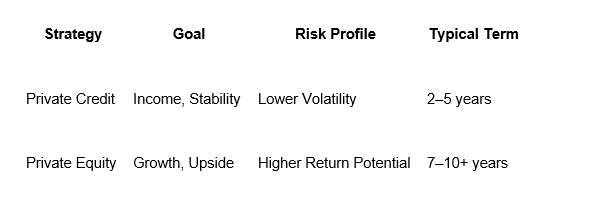
By combining these approaches,investors can achieve a diversified risk/return profile while gaining exposure to private markets that are less sensitive to public sentiment.
Before You Invest: Key Considerations
Private credit and private equity represent the cornerstone of modern alternative investing. When used together,they offer distinct advantages that can enhance both return potential and portfolio resilience.
But before allocating capital, ask yourself:
● What is my time horizon and liquidity need?
● Am I prioritizing income,long-term growth, or both?
● How will these investments complement my broader strategy?
● Has sufficient due diligence been done on the fund manager and structure?
The private markets offer tremendous opportunity—but selectivity is essential.
Navigate Private Markets With Confidence
The alternative investment universe is vast, and quality varies widely. At HUDSONPOINT capital, we guide investors through the complexities of private credit and equity with a tailored,high-touch approach, which includes:
● Access to curated private funds vetted for performance and transparency
● Ongoing monitoring of illiquid holdings and manager performance
● Customized portfolios aligned with your income, tax, and estate goals
● Direct access to our network of institutional fund managers
With HUDSONPOINT, you gain more than access—you gain a strategic partner focused on helping you build a smarter portfolio in an increasingly complex world.
Speak to a Private Wealth Manager
Russ Zalatimo is the Founder and Managing Partner of HUDSONPOINT capital, a firm with 28+ years serving investors. He built the company to give retail investors access to institutional-grade alternative investments: real estate, hedge funds, private equity, and venture capital, that were traditionally reserved for the ultra-wealthy.
The opinions expressed are those of HUDSONPOINT capital and not those of Arete Wealth.
Please note that any investment involves risk including loss of principal. This is for informational and educational purposes only and should not be construed as investment advice or an offer or solicitation of any products or services. Opinions are subject to change with market conditions. The views and strategies may not be suitable for all investors and are not intended to be relied on for legal or tax advice.
Securities offered through Arete Wealth Management, LLC, members FINRA and SIPC. Investment advisory services offered through Arete Wealth Advisors, LLC an SEC registered investment advisory firm.
Table of Contents
Subscribe to Alt Digest Weekly
Join our mailing list and get updates delivered right to your inbox.

.png)

.png)
Learn How Smart Money Really Invests
Download our whitepaper to learn more about alternative investments and how large financial institutions strategically use alternative assets to maximize their returns.

